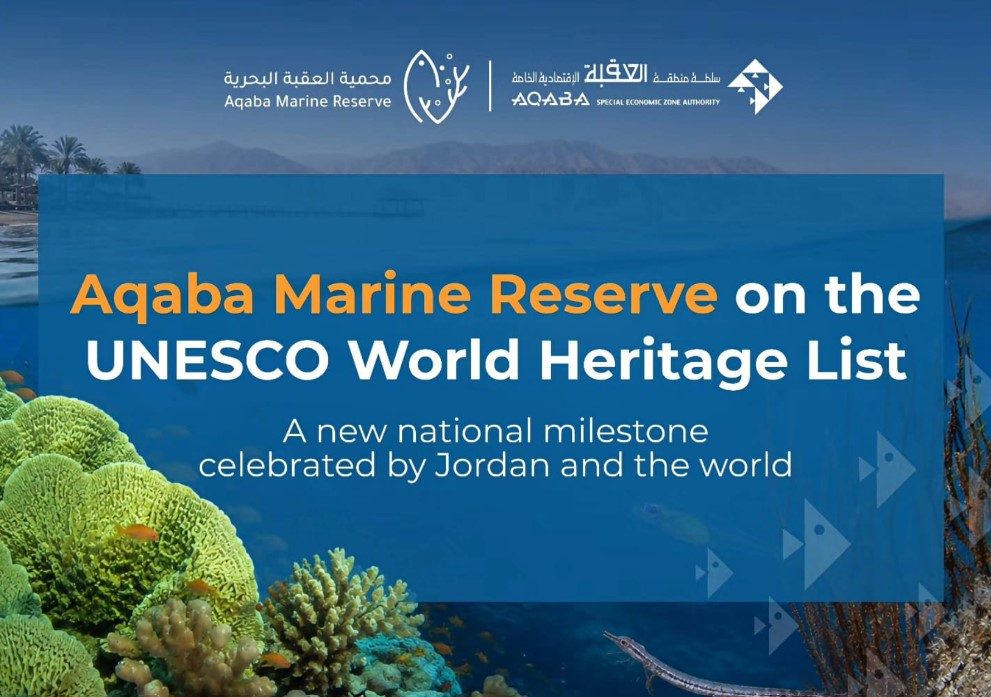
Aqaba Marine Reserve… A Jewel on the World Heritage List
By: Abdulrahim Al-Arjan
Traveler and Researcher in Adventure Tourism
Not every day does a natural site gain global recognition that affirms its exceptional value to humanity. When it comes to the Aqaba Marine Reserve, its inscription on the UNESCO World Heritage List is not merely an environmental achievement, but an international declaration that Jordan is home to one of the world’s most important marine treasures. It confirms that Aqaba is not just a coastal city, but a global destination where nature meets history, and development aligns with environmental preservation.
For decades, the Gulf of Aqaba has amazed scientists and divers with its rare coral reefs, extraordinary biodiversity, and ecosystems with remarkable resilience to climate change. Today, this international recognition grants Jordan a historic opportunity to transform this natural heritage into a cornerstone of sustainable eco-tourism.
Sites inscribed on the World Heritage List attract millions of tourists worldwide, as they represent human, cultural, and natural value. Thus, the inclusion of the Aqaba Marine Reserve will place Jordan on a new map of eco-tourism, drawing niche visitors such as divers, photographers, researchers, and nature enthusiasts—groups known for high spending and respect for the environment and local communities.
The impact of this achievement extends to the national economy by revitalizing tourism, encouraging investment in sustainable environmental projects, creating new jobs in eco-guiding, diving, scientific research, and tourism services, while strengthening Aqaba’s position as a regional hub for marine tourism.
This milestone would not have been possible without the continuous efforts of the Aqaba Special Economic Zone Authority, in cooperation with the Ministry of Environment, the Ministry of Tourism and Antiquities, the Jordanian National Commission for UNESCO, and various national partners, in protecting the marine environment, preserving coral reefs, and developing reserve management systems according to international best practices. This institutional work highlighted the outstanding universal value of the Aqaba Marine Reserve and established its place as one of the region’s most important natural sites, reflecting a successful Jordanian model in balancing economic development with the conservation of natural heritage.
Cultural tourism is no less important than eco-tourism in this context. Aqaba is an ancient city that has witnessed successive civilizations and served throughout history as a gateway for trade and communication among peoples. When a tourist explores coral reefs in the morning and strolls through historical sites and local markets in the evening, they experience a holistic journey that blends nature, culture, and human heritage.
Jordan, which has successfully registered iconic sites such as Petra, Wadi Rum, Umm al-Rasas, and Bethany Beyond the Jordan, has now added a new marine jewel to its international achievements. This enhances the Kingdom’s image as a destination that combines cultural and natural heritage within a small geographic area rich in diversity and unique experiences.
The inscription of the Aqaba Marine Reserve on the World Heritage List is not the end of the road, but the beginning of a new phase requiring a national vision to leverage this achievement in global promotion, develop eco-tourism products, empower local communities, investors, and scholars to benefit from the opportunities it provides, while maintaining the delicate balance between development and nature conservation.
Aqaba today offers the world not only a beautiful sea, but a Jordanian model proving that environmental protection can be a gateway to development, and that investing in natural heritage is a profound investment in the nation’s future and its standing on the global tourism map.
This step aligns with the objectives of Jordan’s Economic Modernization Vision, which places tourism at the forefront of growth-driving sectors, emphasizes the importance of diversifying tourism products, attracting quality investments, and enhancing Jordan’s competitiveness globally. Eco-tourism and cultural tourism are no longer mere leisure activities, but knowledge-based, sustainable, and innovative economic sectors capable of creating jobs, fostering local development, and supporting communities around natural and heritage sites.
Thus, capitalizing on the global status of the Aqaba Marine Reserve is part of an integrated national strategy linking sea to desert, nature to heritage, to deliver a unique Jordanian tourism experience stretching from the depths of the Gulf of Aqaba to Petra, Wadi Rum, and Bethany Beyond the Jordan—strengthening the Kingdom’s position as one of the leading sustainable tourism destinations in the Middle East and the world.